
Florida Medicaid · Qualified Income Trusts (Miller Trusts)
Too much income for Medicaid? Find out whether you need a QIT, and what to do next.
In Florida, a person whose gross monthly income is over the Medicaid income limit cannot get long-term care coverage unless they have a Qualified Income Trust. Our QIT Review looks at your family's own figures and explains, in writing, whether a QIT is needed, how much goes in each month, and which account pays each bill.
Florida's income limit for long-term care Medicaid is $2,982.00 a month in 2026, measured on gross income.
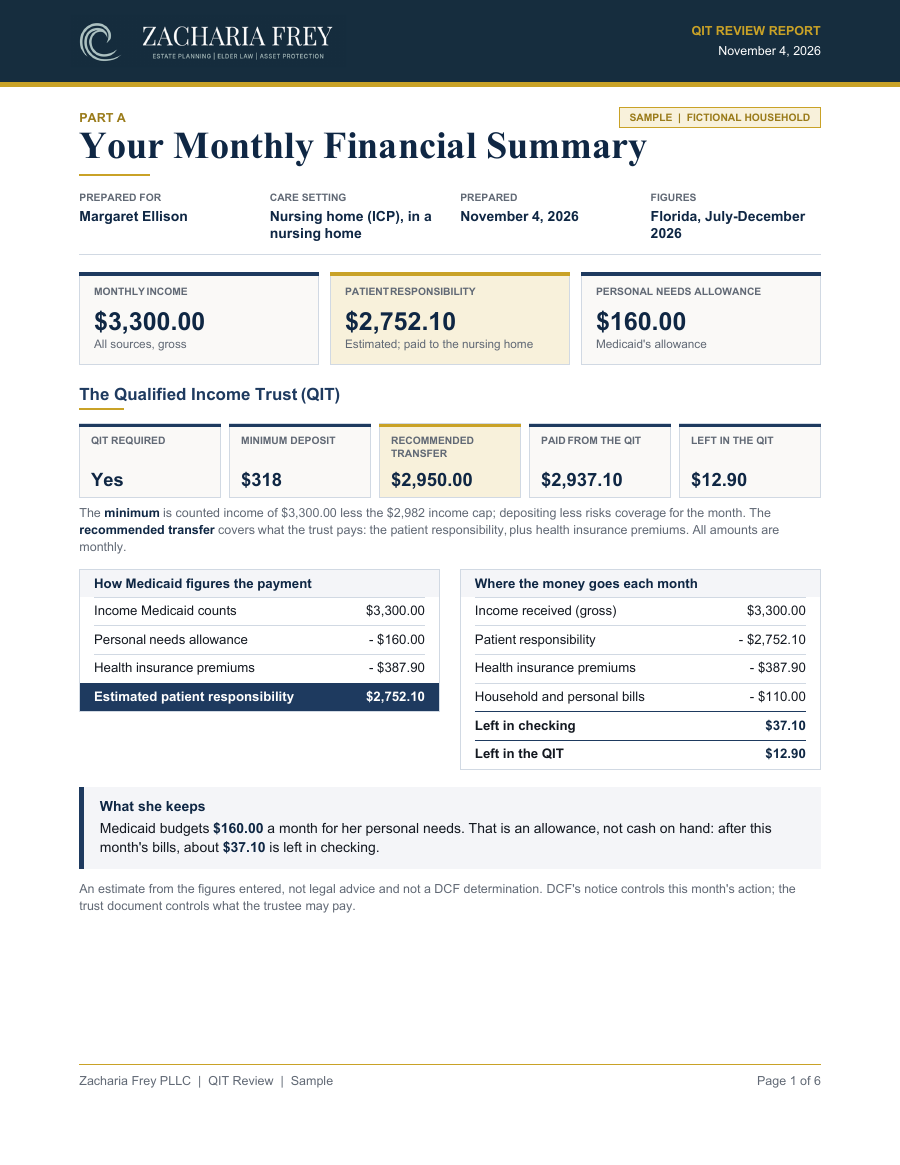 Read the whole sample
A report built around your family's numbers
Families can find general information about QITs anywhere. What they cannot find is how the rules apply to their own income, their care setting, their bills, and, when there is one, their spouse. That is what the review is for.
It opens with a practical summary: what we concluded, the figures we used, and what to do next. The detailed calculations follow. Every figure is checked against your documents, because the gross Social Security benefit, not the bank deposit, is what DCF counts.
Your QIT Review covers
- Whether a QIT appears to be needed
- The monthly deposit into the trust
- Estimated patient responsibility
- Which account pays each bill
- How a spouse's income and costs affect the plan
- Issues to resolve and next steps
How the QIT Review works
- 1
Tell us about your situation
Send a short request: who the trust is for, the care setting, and how to reach you. Our office calls within one business day to explain the review and the fee and to tell you which documents to send.
- 2
We check the figures and write your report
The firm checks the income, premiums, and bills against your documents, then prepares a personalized report and monthly plan and goes over it with you.
- 3
Put the plan to work
Follow the monthly routine with the one-page summary for the facility or provider. If the trust itself is needed, the firm can prepare it.
What a QIT is, in one minute
A Qualified Income Trust is a short, irrevocable trust with its own bank account. Each month, part of the person's income moves from their checking account into the trust. Income in the trust is not counted against the Medicaid income limit, so the person can qualify. From the trust, the trustee pays the monthly share of the cost of care and other allowed expenses. Whatever is left when the person dies goes to the State of Florida, up to what Medicaid paid.
Signing the trust is only the start. Running it is where families get into trouble: a missed month, a deposit figured from the net Social Security deposit instead of the gross benefit, or, at home and in assisted living, putting in so much that there is nothing left for rent and groceries.
Zacharia Frey PLLC. Updated November 2026. Draft for attorney review.
QIT questions, answered
Do I need a Qualified Income Trust in Florida?
You need a Florida Qualified Income Trust if you are applying for long-term care Medicaid and your gross monthly income is over the income limit. How to add up gross income, how an IRA can push it over, and what to do with the answer.
ReadWhat is a Qualified Income Trust (Miller Trust)?
A Florida Qualified Income Trust, or Miller Trust, lets a person whose income is over the Medicaid income limit qualify for long-term care. How it works, who is trustee, and what happens at death.
ReadFlorida's Medicaid income limit for nursing home and long-term care
Florida's income limit for nursing home Medicaid, the long-term care waiver, institutional hospice, and PACE is 300 percent of the federal SSI benefit rate, measured on gross income. What happens when income is over it, and why the limit changes every January.
ReadHow to set up a Qualified Income Trust in Florida
The six steps to set up a Florida Qualified Income Trust: confirm the need, decide who signs, make sure the trust says what DCF requires, open the trust bank account, deposit income in the same month it arrives, and give the trust to DCF with the Medicaid application.
ReadFunding a QIT: nursing home, home care, assisted living, and PACE
The Florida income limit is the same for nursing home Medicaid, the long-term care waiver, and PACE, but how much to put in the Qualified Income Trust each month is not. Why depositing all income is right in a nursing home and wrong at home or in assisted living.
ReadManaging a Qualified Income Trust, month by month
How to run a Florida Qualified Income Trust each month: where income lands, when the transfer moves, which bills the trust pays, keeping checking under the asset limit, and the mistakes that cost Medicaid eligibility.
Read
The attorney
Carl B. Zacharia
Carl Zacharia is a founding partner of Zacharia Frey PLLC in Bonita Springs. He has practiced elder law for more than thirty years, has been licensed in Florida since 1995 and in Pennsylvania since 1993, and is a member of The Florida Bar's Elder Law Section. He wrote Florida Long-Term Care and Medicaid: A Family's Guide to Finding, Getting, and Paying for Good Care, which explains Qualified Income Trusts for families.
An attorney reviews every request the firm receives.
About Carl ZachariaQuestions families ask first
- Who needs a Qualified Income Trust in Florida?
- Anyone applying for Florida long-term care Medicaid, in a nursing home, through the home and community-based waiver at home or in assisted living, or through PACE, whose gross monthly income is over Florida's income limit. Without a QIT that person cannot qualify, even with very few assets.
- Does income over the limit mean my parent can never get Medicaid?
- No. That is what the QIT is for. When the income over the limit is deposited in a properly drafted Qualified Income Trust every month, it is not counted against the limit.
- Is the QIT Review the same as preparing the trust?
- No. The review explains whether a QIT is needed and how it should run each month. If your family needs the trust itself, the firm prepares that too. The office explains the fee for each when it calls.
- What is the difference between a QIT and a Miller Trust?
- None. They are two names for the same trust.
Prefer to ask a person?(239) 345-4545[email protected]
You do not have to work through the QIT rules alone
Start with a review of your family's own figures: whether a QIT is needed, how much goes in each month, and which account pays each bill. Our office calls within one business day. Nothing is charged online.